

How To Fix An Infinity Cube
Every cube has six equal sides. These are besides known as faces or facets. Each cube has one face at the acme, one at the bottom, and four around the sides. Dice are examples of cubes, with each of the six sides having a number on it from one through six.
A cube is 3-dimensional. It has 12 edges that are joined together past viii vertices, which are at the corners of the cube. Three sides run across at every vertex. A cube is a hexahedron, meaning information technology has six faces. It'due south also a regular hexahedron, which means all six sides are equal is size. A cube is the merely regular hexahedron.
A cube is also a ideal solid. Read on to find out what that ways and where cubes are plant in everyday life, architecture, fine art and nature.
What Is a Platonic Solid?
A platonic solid is a three-dimensional shape whose faces are polygons that have equal sides. There are five types of platonic solids:
- The tetrahedron (pyramid) has three faces.
- The hexahedron (cube) has four faces.
- The octahedron has five faces.
- The dodecahedron has 12 faces.
- The icosahedron has 20 faces.
All platonic solids are regular, meaning they have equal sides and angles, and each ane has an equal amount of sides meeting at every vertex. Each polygonal side is congruent, meaning the size and shape of every side is identical.
Platonic solids were given their name because of the studies of philosopher Plato. He attributed the shapes to burn down, globe, air, h2o and the heavens and based his theory about the universe on them. The cube, according to Plato, was assigned to the earth considering of its four-square regularity, according to Britannica.
Eastward veryday Cubes
Y'all see cubes around you lot every day. Y'all put saccharide cubes in your hot drinks and ice cubes in drinks to brand them colder. Some tissue boxes are cube-shaped equally are some ornamental planters and ottomans. Babies and toddlers learn motor skills when they play with cube-shaped edifice blocks.
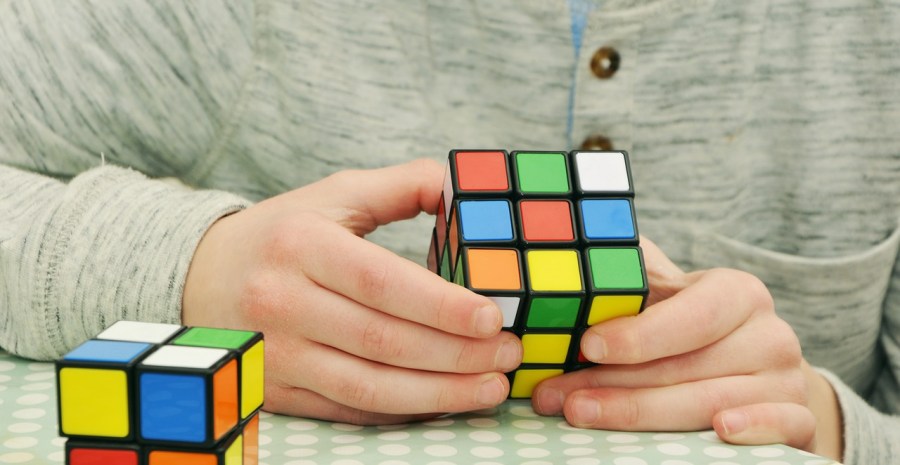
A famous cube is the Rubik's cube. Kids and adults alike love this cube-shaped puzzle. Information technology was invented by a Hungarian professor of architecture named Ernõ Rubik in 1974. The Magic Cube, every bit Rubik first called information technology, is comprised of smaller cubes, and each side of the principal cube displays nine colored squares. What started out every bit a movable prototype to assistance his architecture students soon became a bestselling toy, leading to world championships in solving the puzzle, spin-off products and speedcubing.
C ubes in Architecture
The regular, symmetrical shape of a cube makes it easy to build with. Architects consider the geometrical design to exist a sign of perfection when information technology comes to structures. Many famous buildings have been designed in the shape of cubes.
The Mirrorcube is actually a hotel congenital in the trees in Sweden. The mirrored walls camouflage the accommodation amid its surround.
The Apple Cube is the iconic glass cube entrance to Apple's flagship store on Fifth Avenue, New York City. Once you've entered the striking glass entrance, a screw staircase leads you down into the store.
In Lyon, France, the Orangish Cube sits on the bank of the river, housing offices inside its intriguing design. With giant-sized voids in the sides of the building, it almost looks equally though someone has taken a seize with teeth or two from it.
C ubes in Fine art
In the early 20th century, a revolutionary art movement called cubism was introduced by the artists George Braque and Pablo Picasso. The subject matter was comprised of cubes and various other geometrical shapes rather than existence a true-to-life copy of what was seen. It led the fashion for abstract art and inspired creative fine art movements in the future, such as surrealism and futurism.
For display purposes in galleries and museums, the "white cube" is recognized for being the all-time surrounding to showcase artworks. The white, foursquare walls preclude your optics from beingness distracted from the artwork hanging on them, helping to highlight the colors and details within them.
Drawing cubes also helps with perspective in art and can brand it easier to depict some items, such as figures. Artists too use cubes in artwork to draw the viewer'due south heart to a item detail, such as light, shadow, colors or materials used.
C ubes in Nature
It may seem strange to remember of cubes naturally occurring in nature due to their geometrical shape and rigid lines. Nevertheless cubes in nature do be.
A mineral called pyrite is made of cuboidal crystals that result from ii sulfur atoms bonding with an iron atom. Halite crystals are cubic besides, and yous'll know this mineral better every bit rock table salt.
Possibly the most unusual case of cubes in nature is wombat poop. Wombats have incredibly dry out carrion due to their habitat. It's believed this helps keep the cube structure intact when excreted, having been molded into a cube shape at the end of the intestinal tract.
Source: https://www.reference.com/science-technology/many-sides-cube-e8f09baafbd0f960?utm_content=params%3Ao%3D740005%26ad%3DdirN%26qo%3DserpIndex&ueid=de16272a-0851-4cc9-82f2-f4eb1f9b0acc
0 Response to "How To Fix An Infinity Cube"
Post a Comment